
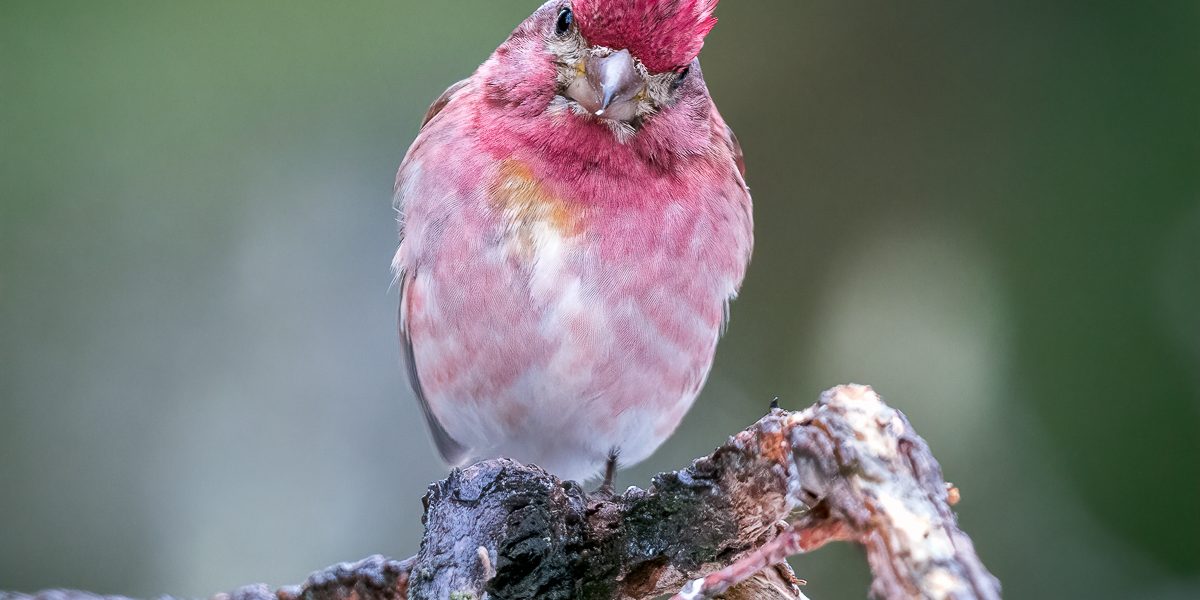
Standing at my feeder last winter, I watched two rosy-red birds land on the same perch. One was a house finch I'd seen dozens of times. The other looked richer, fuller, almost dipped in raspberry juice. That second bird was a purple finch, and the side-by-side made every difference click into place. If you've been second-guessing yourself at the feeder, this guide walks through the exact markers I use to tell them apart.
At a Glance: The Fastest Way to Tell Them Apart
Before we go field mark by field mark, here's a quick reference that covers the most reliable differences. One or two of these is usually enough to make the call.
- Color richness. The male purple finch looks dipped head-to-tail in raspberry, with color flowing evenly across the head, back, chest, and flanks. The male house finch shows brick-red or orange-red patches concentrated on the forehead, chest, and upper shoulders, fading into streaky brown below.
- Body shape. Purple finches are chunkier and more compact, almost like they're wearing an extra layer. House finches are slimmer and slightly longer-tailed, with a more delicate frame.
- Bill shape. The purple finch has a shorter, thicker bill, built for cracking tough seeds. The house finch bill is longer and more curved, better suited for precise seed picking.
- Female face pattern. The female purple finch has a bold white eyebrow stripe and a dark cheek patch that creates a masked look. The female house finch has a plainer, more uniformly streaky face without that strong contrast.
- Belly streaking. House finch males have visible dark streaks on the belly below the red. Male purple finches have a mostly clean, unstreaked underside.
- Tail shape. Purple finches have a shorter, more notched tail. House finches carry a longer tail that looks slightly forked.
Keep those six points in your back pocket and you'll get it right more often than not, even on quick glances.
Color: Males Side by Side
Color is where most people start, and it's genuinely useful once you understand what you're actually comparing. The difference isn't just shade; it's coverage and quality.
The male house finch wears red like a stain that didn't spread all the way. It concentrates on the forehead, eyebrow, chin, and upper chest, then fades into brown streaking on the belly and flanks. In some individuals it tips orange. The coloring looks patchy, variable, and a little uneven.
The male purple finch looks like a different category of bird. That raspberry wash covers the entire head, neck, chest, back, and flanks in a smooth, even tone. I always describe it to new birders the same way: if the house finch is a splash of paint, the purple finch is a full dip. On a bright day, the richness of a male purple finch is hard to miss.
Color: Females Side by Side
Female finches don't show any red, so color alone won't save you here. The key is facial contrast, and the two species are strikingly different when you know what to look for.
- Female purple finch. Look for a bold white eyebrow stripe above the eye and a dark cheek patch below it. That combination creates a masked, expressive face. The streaking on the breast is thick and clearly defined. The overall pattern looks crisp, almost like a miniature thrush.
- Female house finch. The female house finch has a plain, unmarked face without the strong white eyebrow or contrasting cheek. She's streaky brown throughout, and the streaking on the breast tends to be finer and more evenly distributed. She blends easily into the background.
When I spot a brown finch with an expressive, patterned face, I know immediately it's a female purple finch. Plain face, plain bird: house finch.
Size, Shape, and Body Structure
Shape is often the first thing your eye registers before color even registers. These two species have genuinely different silhouettes.
- Purple finch. Compact and chunky, with a rounded head, short neck, and broad chest. Their shorter, notched tail reinforces the stocky impression. Their wings look broader relative to body size.
- House finch. Slimmer and more elongated, with a slightly flatter head profile. Their tail is longer and tends to look slightly forked. They carry themselves with a more delicate, upright posture.
When both species are at the feeder together, the size and shape difference becomes obvious. Purple finches look substantial. House finches look lightweight. This works at a distance even when color and markings are hard to read.
Bill Shape
Bill shape is one of the most reliable field marks, especially for birds perched at an angle where body color is hard to judge. The purple finch has a short, deep, powerful bill, noticeably thick from the side. It's built for cracking conifer seeds and tougher hulls. The house finch has a longer, more curved bill that tapers to a finer tip, well suited for picking apart sunflower seeds and millet. Once you've seen both side by side, the bill difference is hard to unsee.
Song and Calls
If you hear them before you see them, song can clinch the ID. The two species sound distinct once you know what to listen for.
- House finch song. Cheerful, bouncy, and slightly metallic. Their song rises and falls quickly with a buzzy quality at the end of some phrases. Common in suburban areas almost any time of year.
- Purple finch song. Richer, more fluid, and more musical. The melody flows with a warbling, lyrical quality that feels more polished. It's less buzzy than the house finch and has a smoother finish. Learning to identify finch species by their song is one of the fastest ways to level up your identification skills in general.
Both species also give a sharp "pit" or "tick" call note in flight. The house finch call tends to be a bit softer and more conversational; the purple finch call can sound slightly harder and more emphatic, though this takes practice to hear reliably.
Range and Habitat
Where and when you spot a finch gives you useful context before you even look at field marks. House finches are year-round residents across most of the US and are deeply comfortable in suburban and urban environments. They nest in eaves, hanging baskets, and tree cavities in residential neighborhoods, and they show up at feeders reliably every day of the year.
Purple finches have a more complex range. They breed mainly in Canada and the northeastern US, but they winter more broadly across the east and west coast. In some years, food scarcity drives large southward movements, and that's when they show up at feeders in numbers. If you're seeing an unfamiliar rosy finch in winter, especially in a wooded or edge habitat, purple finch is always worth considering. Understanding the migration patterns of wild finches adds a lot of context to what you're seeing in your yard.
Feeder Behavior
Behavior at the feeder is a secondary cue, but it's worth noting because the two species have genuinely different personalities. House finches are bold and accustomed to people. They'll hop onto a feeder while I'm still refilling it, squabble quickly with each other, and settle into a comfortable pecking order. They're generalists: sunflower, millet, fruit, buds in spring.
Purple finches are more cautious visitors. They tend to watch from a nearby branch before committing to the feeder, and they move more deliberately once they land. Their thicker bill makes them especially efficient at cracking sunflower and conifer seeds. They're not daily regulars in most yards the way house finches are, which makes each visit feel a little more like a reward.
Common Mix-Ups and Why They Happen
Even experienced birders get these two wrong in certain conditions. A few situations that cause trouble:
- Worn summer plumage. By late summer, a house finch male's red can fade and dull, making it look richer and more even than usual. Check body shape and bill size when color looks ambiguous.
- Evening light. Late-day golden light can make a house finch look far more purple than it is. If the light is warm and dramatic, don't trust color alone.
- Female purple finch vs. sparrow. The female house finch and female purple finch both get confused with various sparrows. The bold face pattern of the female purple finch (white eyebrow, dark cheek) is the thing that separates her from sparrows and from the plainer female house finch alike.
- Juvenile birds. Young house finches look like adult females: fine brown streaking, plain face. Juvenile purple finches show the same bold facial contrast as adult females. The face pattern holds up across age classes, which makes it consistently useful. If you're new to sorting out juveniles and adults, reading up on color variations in finches helps set expectations for how much individual birds can vary.
The most reliable move when you're unsure is to anchor on shape and bill, not color. Those features don't change with light or season.
Quick ID Summary by Feature
Here's how the two species stack up across every major field mark, all in one place.
- Male color. Purple finch: deep raspberry wash, head to flank. House finch: brick-red patches on forehead and chest, fading to streaky brown.
- Female face. Purple finch: bold white eyebrow, dark cheek mask. House finch: plain, uniformly streaky, no contrast.
- Body shape. Purple finch: chunky, compact, rounded. House finch: slim, elongated, more delicate.
- Bill. Purple finch: short and thick. House finch: longer and more curved.
- Belly. Purple finch male: mostly clean, unstreaked. House finch male: streaked below the red.
- Tail. Purple finch: shorter, notched. House finch: longer, slightly forked.
- Song. Purple finch: rich, fluid, warbling. House finch: bouncy, slightly buzzy.
- Habitat. Purple finch: wooded and edge habitat, winter visitor in many areas. House finch: year-round suburban resident.
When you stack these up, you can see why the two species look so similar at first but feel so different once your eye is trained. If you want to understand more about how finch species differ from each other, that same attention to body structure and behavior carries over to other species comparisons too.
FAQs: Purple Finch vs. House Finch?
Here are the questions I hear most when people are sorting out these two common backyard birds for the first time.
Is the purple finch actually purple?
Not really. The name is a bit misleading. The male purple finch is a rich raspberry-red, and in certain light it can look slightly rosy or vinous, but it's not what most people would call purple. The name likely comes from older English usage where "purple" could describe deep reddish-crimson tones.
Which is more common at backyard feeders?
House finches are far more common and more consistent at feeders across most of the US. Purple finches visit more sporadically, mostly in winter, and are more likely in wooded or edge habitats than in dense suburban neighborhoods.
What's the single best field mark to separate them?
For males, it's the quality and coverage of the red color. The male purple finch looks uniformly dipped in deep raspberry; the male house finch shows patchy brick-red concentrated on the face and chest. For females, it's the bold white eyebrow stripe on the female purple finch, which the female house finch completely lacks.
Can house finches and purple finches interbreed?
There are no confirmed cases of natural hybridization between the two species. They're related but distinct, and their different habitat preferences and ranges keep them largely separate during breeding season. If you're curious about finch hybridization more broadly, it's a genuinely interesting area with ethical dimensions worth exploring.
The More You Look, the Easier It Gets
The first time these two land at your feeder together, let yourself look slowly. Give the bird a full thirty seconds rather than a quick glance. Body shape, bill thickness, belly streaking, face pattern: once those clicks into place for a real bird in real light, you stop second-guessing. The purple finch feels like a reward for patience. The house finch feels like an old friend. Both are worth learning well.