
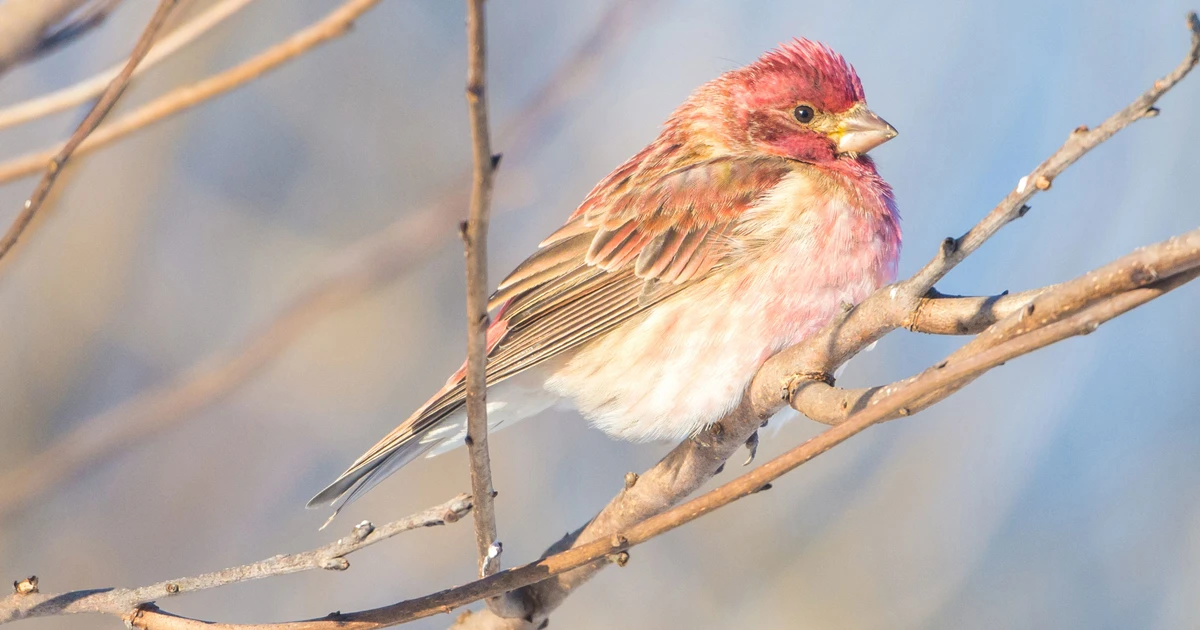
Every finch keeper I know started with a zebra finch or a society finch. That's a perfectly reasonable entry point. But the Fringillidae family, the true finches, runs to hundreds of species worldwide, and most of them never show up in a pet shop or a backyard feeder guide. After years of keeping birds and obsessing over field guides, I've built up a real appreciation for the ones that get overlooked. Some are wild species you might spot if you travel; others show up occasionally in the pet trade. All of them are worth knowing about.
Here are ten lesser-known finch species that stand out for their looks, their behavior, or their quiet strangeness. For each one I've included where they live, what makes them distinct, and whether they're ever kept as pet finches.
Twite
The twite is a hardy northern finch that most people walk right past. At first glance it looks like a streaky brown sparrow, but the pinkish rump that flashes in flight during breeding season gives it away. It's common across moorlands, coastal fields, and upland areas of the UK and northern Europe, forming tight winter flocks that descend to saltmarshes and stubble fields when the cold arrives.
A few things set the twite apart from other brown finches:
- Its bill turns a bright yellow in winter, which is surprisingly striking on such a modest bird.
- It feeds heavily on the seeds of coastal plants and weeds, making it a specialist in marginal habitats that other species avoid.
- Numbers have declined significantly in recent decades due to agricultural changes, so seeing a winter flock now carries a certain weight.
- It's closely related to the linnet but has a noticeably more nasal, buzzing call.
The twite isn't kept as a pet finch in any meaningful numbers, but it's one of the most rewarding wild species to learn to identify. Once you know the call, you hear it everywhere on a windswept coast.
Lesser Redpoll
The lesser redpoll is a tiny, acrobatic finch that feeds upside down in birch and alder trees, often alongside siskins. It has a streaky brown body, a small red cap on the forehead, and in breeding males, a rosy-red flush on the breast that can be surprisingly vivid. Distribution spans boreal forests across northern Europe and North America, though winter movements bring them much further south to gardens and woodland edges.
What makes the redpoll interesting to me is the sheer variation within the species complex. The common redpoll, lesser redpoll, and hoary redpoll debate has kept taxonomists busy for decades. The lesser redpoll is the smallest and darkest of the group, and telling them apart on a winter feeder is genuinely difficult:
- Size. The lesser is noticeably compact compared to common redpolls, roughly the size of a blue tit.
- Plumage. Streaking is denser, and the buff wingbars are a useful ID feature.
- Males. A breeding male with a full red breast and cap is unmistakable once you've seen one.
- Females. Females are plainer, with just the red cap and lighter overall streaking.
Redpolls occasionally appear in aviculture, particularly in Europe. They're not beginner birds, but experienced keepers find them rewarding because of their activity level and their habit of singing even in winter.
Eurasian Siskin
The siskin gets more attention than most birds on this list, but it's still underappreciated as a keeper's bird. It has a yellow-green body with black wing markings, and males carry a neat black cap that makes them look permanently businesslike. The distribution runs across Europe and Asia, with partial migration that brings siskins to garden feeders in large numbers during winter irruption years.
Siskins are a familiar sight at nyjer seed feeders, and they tend to arrive in chattering flocks that strip a feeder fast. Their behavior at feeders is worth watching:
- They readily mix with lesser redpolls and goldfinches, which makes mixed flock ID a useful exercise.
- Males are noticeably brighter than females, which have a more olive, streaked appearance.
- Their call is a distinctive rising "tseee" that carries well through woodland canopy.
- In good years, they'll visit garden feeders in numbers well into spring, singing from the tops of conifers.
In captivity, siskins are kept by specialist finch breeders across Europe. They need space and a varied diet with plenty of nyjer and other fine seeds. If you're already keeping beginner-friendly finch species and want to add something more specialized, the siskin is a logical step.
European Serin
The European serin is the wild ancestor of the domestic canary, which already makes it worth knowing about. It's a small, yellow-mottled finch with a rapid, tinkling song that sounds like seeds rattling in a tin. Common across southern and central Europe, it's adapted well to urban gardens, parks, and orchards, which means it's accessible to birders who rarely leave the city.
Most people outside Europe have never heard of the serin, even though it's genuinely common in its range. Some standout characteristics:
- Males are brighter yellow than females, with a small but striking yellow rump visible in flight.
- The song is delivered at high speed in a sustained, buzzy stream, quite different from the melodic canary song it gave rise to.
- It nests readily in parks and gardens, even in busy city centers, which is unusual for a finch this size.
- The conical bill is adapted for small seeds from grasses and weeds, including those that colonize disturbed ground.
The serin is rarely kept as a pet outside its native range, but it crosses easily with domestic canaries. Understanding the serin adds real context to canary history, and it's a natural pairing with any interest in exotic finch species and their care requirements.
Crimson Finch
If understated birds aren't your thing, the crimson finch is the opposite end of the spectrum. Native to northern Australia and New Guinea, it has deep red plumage across the face, breast, and flanks, with darker wings and a long, tapered tail. It's one of the most visually dramatic finches in the world, and it's barely known outside aviculture circles and Australia.
Crimson finches live near water: wetlands, reed beds, pandanus palms, and tall grass along tropical rivers. Their habits reflect that habitat preference:
- They feed on grass seeds and small invertebrates, often foraging low in dense vegetation near the water's edge.
- Males display in short, hovering flights during breeding season, fanning the tail to show off the red plumage.
- They're territorial and can be aggressive toward other finches in the aviary, so housing requires thought.
- Two subspecies exist, with the northern form having a black belly patch that the southern form lacks.
In aviculture, the crimson finch is kept by experienced finch breeders who appreciate the challenge. They're not recommended alongside smaller or more passive species. That said, a well-managed aviary with a pair of crimson finches in breeding condition is genuinely hard to look away from.
Black-Throated Finch
The black-throated finch is a quiet, gray-bodied Australian grassland finch with a solid black throat patch that makes the ID simple. It inhabits grassy woodlands and open savannas in Queensland, where wet and dry seasons shape everything about how it feeds and breeds. It's gentle in temperament, undemanding in appearance, and has been pushed to the edge of survival by habitat loss.
Conservation status is the reason to know this species. Broad-scale land clearing in Queensland removed a huge portion of its habitat over the past century, and the southern subspecies is now critically endangered. A few things worth understanding:
- The species feeds almost entirely on grass seeds, which makes it highly dependent on intact grassy woodland habitat.
- It nests in grass stems or low shrubs, and nest failure rates rise sharply in degraded habitat.
- The northern subspecies retains a viable wild population, but the southern subspecies has been functionally lost from most of its former range.
- Captive breeding programs exist, and it occasionally appears in specialist aviculture in Australia.
The black-throated finch doesn't look flashy. But knowing what it represents, and what's been lost, makes spotting one in the wild feel significant in a way that a common bird rarely does.
Andean Siskin
The Andean siskin occupies a narrow band of cloud forest in South America, living at elevations that most bird species avoid. It has a greenish-yellow body with darker wing markings, looking a bit like a smaller, sleeker version of the Eurasian siskin, but adapted to the wet, mossy forests of the Andes. Its distribution runs through Colombia, Ecuador, Peru, and Bolivia at elevations between roughly 1,500 and 3,500 meters.
What I find most interesting about this species is how it handles an environment where food supply is unpredictable:
- It moves through the canopy in small, restless flocks, covering ground efficiently as it searches for seed-bearing plants.
- Diet includes seeds, small insects, and flower buds, which gives it flexibility when one food source is scarce.
- Males and females look similar, which is unusual for a siskin, though males tend to be slightly brighter yellow-green.
- The altitude it prefers means plumage has to cope with temperature swings that would stress most small birds.
The Andean siskin isn't kept in captivity at any scale. It's a bird for field birders with South American itineraries rather than aviculture, but its presence on this list is a reminder of how many siskin-type finches exist beyond the familiar European species.
White-Winged Crossbill
The crossbills deserve a place on any list of distinctive finches, and the white-winged crossbill is the most visually striking of the group. Its bill tips cross each other, an adaptation so specific to conifer cone opening that it's hard to look at without feeling impressed. The white-winged crossbill adds two bold white wingbars to the standard crossbill look, making it cleanly identifiable even in bad light.
Its habitat and behavior are unlike any other finch family member:
- It specializes in tamarack, spruce, and other conifers, using the crossed bill to pry scales apart and extract seeds with the tongue.
- Rather than following fixed migration routes, it wanders nomadically across boreal forest in search of cone crops, so it can appear almost anywhere in a good year and be completely absent in a poor one.
- Males are a vivid brick-red; females are olive-yellow. The difference in plumage between sexes is one of the most dramatic in the finch world.
- They breed whenever cone crops are sufficient, which can mean nesting in winter if the food supply supports it.
The white-winged crossbill isn't kept as a pet finch in any practical sense. But understanding how crossbills evolved, and what that crossed bill actually does, gives you a new appreciation for how far finch specialization can go. It makes a natural conversation topic alongside discussions of finch species selected for specific traits by breeders.
Scaly-Breasted Munia
The scaly-breasted munia is technically in the estrildid finch family rather than true Fringillidae, but it lives and feeds like a classic seed finch and belongs in any practical guide to lesser-known species. The scale-like chest pattern that gives it its name is genuinely unusual, made up of brown and white feather edges that create an overlapping effect across the breast and flanks. It's widespread across South and Southeast Asia and has established feral populations in parts of Australia, California, and Hawaii.
It's worth knowing for a few reasons:
- It adapts readily to human-altered landscapes, including rice paddies, farm edges, and suburban gardens, so you can encounter it in places you wouldn't expect.
- It forms large winter flocks that can number in the dozens or hundreds, often mixing with other munia species.
- In aviculture it's calm, hardy, and relatively easy to breed, making it a practical choice for keepers who want a different look from the standard zebra or society finch.
- Males and females look nearly identical, which means sexing relies on behavior rather than plumage.
If you're already managing a mixed-species aviary, the scaly-breasted munia fits in well with similarly sized, non-aggressive species. Its unusual patterning is the kind of thing visitors always notice and ask about.
Golden-Browed Chlorophonia
The golden-browed chlorophonia is the most visually arresting species on this list and possibly one of the most colorful finch-adjacent birds in the world. Its body is a deep emerald green, with a turquoise crown, bright yellow brow stripe, and contrasting yellow and olive underparts. It lives in humid mountain forests of Central America, particularly Guatemala, Honduras, and southern Mexico, where its colors serve as camouflage against moss-covered branches.
It sits in the tanager subfamily within Fringillidae, which explains the extraordinary plumage. A few things that set it apart:
- Males are significantly more colorful than females, which have a softer, more olive-toned version of the same pattern.
- Diet includes fruit, seeds, and small insects, with mistletoe berries being particularly important in some areas.
- It moves quickly through the canopy in pairs or small family groups, rarely staying in one spot long enough for a full view.
- It isn't kept as a pet finch in any regular capacity, as habitat-collected birds don't adapt well to captivity.
The chlorophonia isn't something most finch keepers will ever encounter in person. But it makes a useful counterpoint to the idea that finches are all small, brown, and understated. This family contains some of the most spectacular plumage in the bird world, and the golden-browed chlorophonia is proof of that.
What These Species Have in Common
Looking across this list, a few themes emerge. Most of these birds occupy narrow, specific habitats: boreal forest, cloud forest, wetland edges, high moorland. That specialization is what makes them so interesting, and it's also what makes several of them vulnerable. The black-throated finch has lost most of its range to land clearing. The twite has declined sharply across the UK due to agricultural intensification. The white-winged crossbill depends on cone crops that are growing less predictable as forest ecosystems shift.
Understanding lesser-known finch species isn't just a birdwatching exercise. It builds a clearer picture of how varied the finch family really is, and how the same basic body plan, a conical seed-cracking bill and compact frame, has produced birds that live everywhere from Andean cloud forest to Arctic boreal zones.
For keepers, some of these species represent the next level beyond the common pet finches most people start with. The crimson finch, siskin, scaly-breasted munia, and redpoll all appear in specialist aviculture with varying care demands. None of them are beginner birds, but none of them are impossible either. The main thing is doing the research before acquiring, understanding habitat needs, social requirements, and diet specifics for the species you're interested in.
FAQs: Lesser-Known Finch Species
Here are the questions I hear most often when this topic comes up:
What makes a finch "lesser known"?
It usually means the species isn't commonly kept as a pet, doesn't appear regularly at backyard feeders in North America or Western Europe, and doesn't show up in mainstream birding guides aimed at casual observers. Many of the most interesting finch species fall into this category simply because they live in remote habitats or have small distributions.
Can any of these species be kept as pet finches?
A handful of them appear in specialist aviculture. The siskin, lesser redpoll, scaly-breasted munia, and crimson finch are occasionally kept by experienced breeders. The others are wild species not suited to captivity, either due to specialized dietary needs or legal restrictions on keeping native wild birds.
How do lesser-known finches differ from true finches?
The term "true finches" refers specifically to the family Fringillidae, which includes siskins, crossbills, redpolls, serins, and the chlorophonias. Species like the scaly-breasted munia and crimson finch belong to Estrildidae, the waxbills and estrildid finches. Both groups share the seed-eating lifestyle and conical bill, but they're not closely related. Most keepers use "finch" loosely to cover both families.
Which of these would work in a mixed aviary?
The scaly-breasted munia is the most practical for a mixed aviary setup. The siskin can work alongside other small finches but needs space. The crimson finch is territorial and should only be kept with species that can hold their own. The twite, redpoll, and crossbill are not typically kept at all, so they're not aviary candidates in practice.
There Are Always More Species to Discover
The ten species here barely scratch the surface. The finch family is one of the largest and most ecologically diverse bird groups in the world, with members adapted to every continent except Antarctica. Every time I pick up a regional field guide, I find something new worth tracking down.
If you're just getting started with finch keeping, begin with the well-documented species and build your knowledge from there. But keep an eye on the broader family. The birds on this list are a reminder that the common names most people know, zebra finch, house finch, goldfinch, represent a tiny slice of what's actually out there.